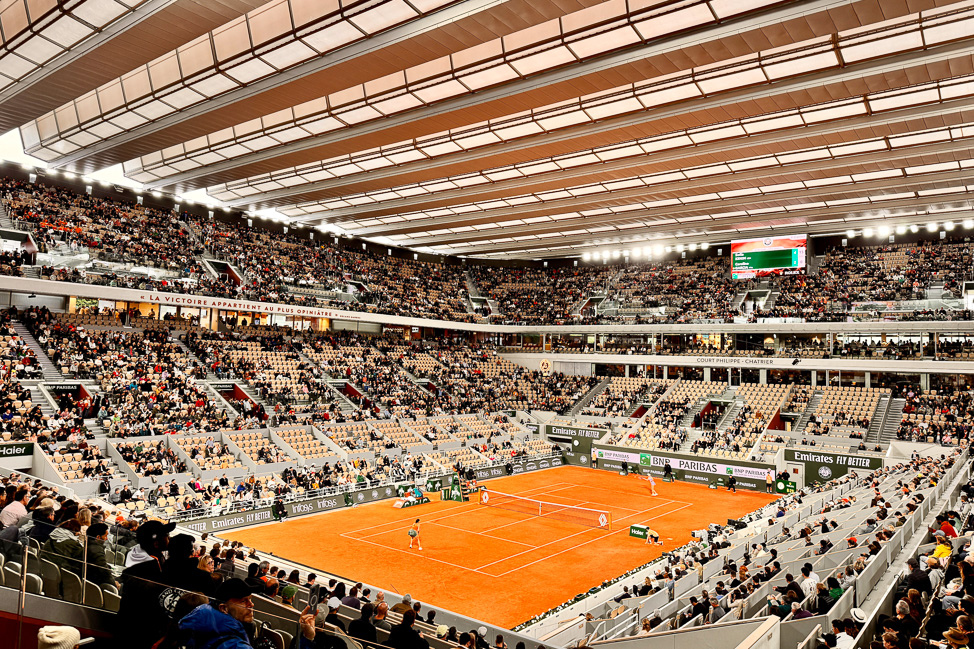
Clay court tennis exists in its own tactical universe — a surface whose specific physical demands, ball behavior, and strategic requirements create matches whose character differs so completely from hard court and grass competition that the french open functions as a genuinely distinct championship from the other Grand Slams rather than simply a variation on the same competitive theme. Roland Garros is where tennis careers are defined, where dominance at other surfaces occasionally fails to translate, and where the specific combination of physical endurance, tactical patience, and clay court technique creates the most demanding championship environment in the sport. Fans following every match with dedicated markets can find comprehensive coverage at dbbetonline.com.
Roland Garros: The Home of Clay Court Tennis
Roland Garros — the complex of courts in the Boulogne-Billancourt district of Paris that has hosted the French Open since 1928 — carries a specific character that no other Grand Slam venue replicates. The intimate relationship between the courts and their Parisian surroundings, the clay’s distinctive red surface whose grinding physical demands separate Roland Garros from Wimbledon’s grass elegance and the US Open’s hard court directness, and the specific history that the venue has accumulated across nearly a century of championship tennis combine to create an atmosphere whose uniqueness the sport universally acknowledges.
The clay surface — crushed brick whose red color comes from the specific material composition that Roland Garros uses — creates the distinctive high-bouncing, low-skidding ball behavior that clay court tactics exploit. Points last longer than on faster surfaces because the clay absorbs pace and spin rather than transmitting it through the bounce — rewarding the patient baseline construction that clay court specialists develop through dedicated surface-specific training rather than the aggressive shot-making that faster surfaces reward more immediately.
The expansion of Roland Garros across recent decades — the addition of Court Suzanne Lenglen alongside the historic Philippe Chatrier as a second major show court, the Simonne Mathieu court’s addition, and the controversial retractable roof installation on Court Philippe Chatrier — has modernized the facility while generating debates about whether the changes improve or compromise the specific character that made the venue irreplaceable within tennis’s grand slam landscape.
The French Open Schedule: How the Tournament Is Structured
The french open schedule runs across two weeks in late May and early June — a timing that creates specific challenges and opportunities whose understanding enriches tournament following beyond simple match result tracking. The European clay court swing that precedes Roland Garros — the Monte Carlo Masters, Madrid Open, and Italian Open creating a four to five week clay preparation period — allows players to build surface-specific form across competitive matches rather than transitioning directly from hard court or indoor conditions.
Early rounds across the first week distribute the 128-player men’s and women’s singles draws — the largest main draws of any Grand Slam — across all available courts simultaneously, creating the logistical challenge of scheduling that exposes every match to the specific Parisian weather variability that late May brings. Rain delays — managed through the Philippe Chatrier roof whose installation addressed the specific scheduling vulnerability that weather created across decades of outdoor-only clay tennis — have become more manageable without being entirely eliminated given that Lenglen and Mathieu remain fully outdoor.
The second week’s progressive concentration — quarterfinals and semifinals reducing the active matches to the schedule’s most prestigious slots on Philippe Chatrier — builds the competitive intensity whose peak arrives across the final weekend when both singles finals create the specific occasions that Roland Garros’s history has made among tennis’s most resonant annual moments.
Rafael Nadal’s Relationship With Roland Garros: The Defining Story
No competitive relationship between an individual player and a specific tournament in any sport approaches what Rafael Nadal built with Roland Garros across his career. Fourteen French Open titles — won across seventeen years of tournament entry, with losses so rare that each one generated specific news cycles — created a dominance whose historical comparison requires inventing new frameworks rather than applying existing sporting superlatives.
The specific explanation for Nadal’s clay court supremacy at Roland Garros combines the technical — his extreme topspin forehand’s interaction with clay’s high-bouncing surface creating ball behavior that even elite opponents found consistently difficult to manage — with the tactical and physical — the endurance-based game that clay’s slower surface rewards and that Nadal’s specific physical preparation prioritized across his career.
His 2022 Roland Garros victory — won despite a chronic foot injury whose management required specific medical intervention and whose physical consequences were visible across portions of the tournament — delivered the fourteenth title that completed the most extraordinary individual-tournament relationship professional tennis has produced. His subsequent retirement creates the specific absence whose weight the tournament’s immediate future carries — Roland Garros without Nadal entering is a different competitive atmosphere whose adjustment the clay court community is still processing.
Men’s Clay Court Competition: The Current Landscape
The post-Nadal clay court landscape has created the most genuinely open men’s Roland Garros competition environment in nearly two decades — a competitive scenario whose uncertainty was largely manufactured by Nadal’s absence rather than by dramatic field quality improvement that his dominance had suppressed.
Carlos Alcaraz’s emergence as the clay court player most capable of occupying the competitive space that Nadal’s retirement created reflects both the specific technical qualities — the topspin construction, the clay court movement, and the competitive intensity — that make him credible as a potential multi-time Roland Garros champion rather than a single-title breakthrough performer. His specific relationship with the French Open — the pressure of being the player most expected to inherit Nadal’s clay court dominance — creates the specific psychological dimension that his performances at Roland Garros carry beyond their competitive results.
Novak Djokovic’s Roland Garros victories — achieved by eventually solving the specific Nadal problem that the clay court’s surface characteristics amplified throughout their rivalry’s most intense years — demonstrated that clay court dominance was not exclusively a Nadal-specific phenomenon but could be achieved by players whose clay court approach differed fundamentally from the extreme topspin baseline game that Spanish clay court tradition produces.
Women’s Clay Court Tennis: Roland Garros’s Different Dynamic
Women’s Roland Garros competition has historically produced more varied champions than the men’s draw — the specific clay court dominance that Nadal represented has no direct female equivalent whose concentration of titles created a comparable competitive certainty across any equivalent period.
Iga Świątek’s French Open dominance across recent years — multiple titles including the specific development of her clay court game from talented young performer to dominant champion — has created the closest approximation to sustained individual Roland Garros supremacy that women’s tennis has produced in the modern era. Her specific technical qualities — the topspin-heavy groundstrokes whose clay court interaction creates the depth and pace variation that clay specialists develop specifically — suit the surface in ways that her overall game quality combined with clay-specific preparation maximizes into tournament-winning performances.
The competitive landscape surrounding Świątek — the challengers whose specific clay court qualities create genuine threat to continued Polish dominance — reflects the broader women’s tennis competitive depth whose unpredictability makes Roland Garros genuinely uncertain across multiple competitive scenarios rather than the near-foregone conclusion that the Nadal era’s men’s draw occasionally approached.
The Tactical Language of Clay: What to Watch
Following Roland Garros intelligently requires understanding the specific tactical dimensions that clay court tennis rewards — the patterns whose recognition transforms watching from passive observation into genuine competitive appreciation whose analytical depth enriches every extended baseline exchange.
Spin generation — the topspin-to-slice variations that clay court tacticians use to alter ball trajectory, bounce height, and pace within rallies — creates the specific tactical texture that clay court tennis expresses more completely than faster surfaces where pace dominates. A topspin-heavy ball landing deep in the corner creates a different competitive problem from a sliced approach shot skidding low to the same location — the receiver’s adjustment requirement across these variations is what clay court tactical intelligence manages across an extended match.
Court construction — the patient building of rally situations whose specific endpoint creates the offensive opportunity that clay’s pace reduction delays relative to faster surfaces — requires the specific physical and psychological endurance that clay specialists develop through surface-specific training whose emphasis differs meaningfully from hard court preparation. Understanding this construction process transforms long baseline rallies from undifferentiated athletic exchanges into genuine tactical conversations whose specific content point-level analysis can decode.
Why Roland Garros Matters to Tennis’s Broader Story
The French Open’s place within tennis’s grand slam framework extends beyond its specific competitive results into what the tournament represents as the sport’s most complete physical and tactical test. Players who win Roland Garros have demonstrated clay court excellence that validates their all-surface quality claims in ways that harder surface titles — achieved through pace and power on surfaces that reduce clay’s specific demands — cannot provide independently.
The all-time legends whose Roland Garros records define the tournament’s history — Nadal’s fourteen titles, Steffi Graf’s six, Bjorn Borg’s six — created the benchmark against which each generation’s clay court pretenders are measured. The tournament’s specific capacity to produce careers-defining performances — the matches whose drama and competitive quality Roland Garros’s specific conditions create more reliably than any other slam — is what makes following the French Open from first round through the final Sunday such a consistently rewarding two-week investment of tennis attention.