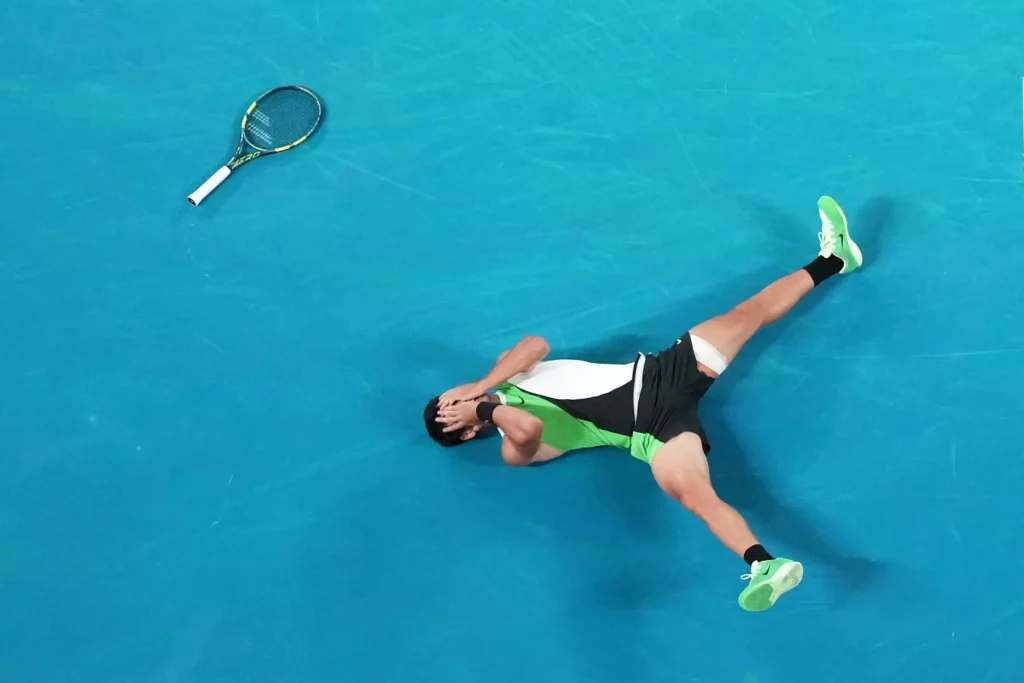
Few athletes have rewritten the record books quite like this Serbian champion, whose relentless pursuit of Grand Slam titles has redefined what longevity looks like in professional tennis. From a teenager battling established stars to a veteran still competing at the sport’s highest level, his career spans an era of tennis history few could have predicted. Fans wanting live scores and tournament coverage can follow every match at dbbet-uz.com, where the action stays current throughout each Grand Slam campaign.
Novak Djokovic’s Early Rise Through Junior and Professional Tennis
Novak Djokovic emerged from a tennis-mad household in Serbia, developing technical fundamentals during a childhood disrupted by conflict that somehow never derailed his singular focus on the sport.
Junior success came quickly, with a technically sound game built around flexibility and return-of-serve precision that set him apart from contemporaries relying more heavily on raw power.
His professional breakthrough arrived amid a golden era of men’s tennis, forcing him to develop mental toughness against established champions who dominated headlines throughout his formative years on tour.
Building a Championship Mentality Through Adversity
Early career struggles against physical fitness issues, including well-documented breathing difficulties during matches, forced significant lifestyle changes that ultimately transformed his on-court endurance and consistency.
Dietary adjustments, particularly eliminating gluten, became a turning point often credited with extending rallies he previously couldn’t sustain against opponents boasting greater physical stamina during five-set matches.
This willingness to overhaul fundamental habits, rather than relying purely on natural talent, established a pattern of continuous adaptation that would define his approach throughout an unusually long competitive career.
The Role of Novak Djokovic’s Coach in Career Development
Guidance from a novak djokovic coach proved instrumental at multiple career inflection points, with tactical adjustments and mental conditioning work often coinciding with periods of renewed dominance on tour.
Coaching changes throughout his career frequently sparked fresh tactical approaches, whether refining serve mechanics or developing more aggressive net play to complement his already elite baseline consistency.
Beyond technical instruction, coaching relationships also addressed psychological resilience, helping navigate pressure during pivotal matches where mental fortitude often mattered as much as physical preparation.
Grand Slam Dominance Across Different Surfaces
Adapting successfully across hard courts, clay, and grass required distinct tactical approaches, since each surface rewards different playing styles and physical demands throughout a lengthy tournament run.
Hard court mastery became a particular hallmark, with return-of-serve consistency and defensive court coverage proving especially effective against power-based opponents who struggled to hit through his positioning.
Clay court success, historically more elusive for baseline counterpunchers, eventually followed through improved patience and shot selection, demonstrating surface versatility that few competitors could match consistently across an entire season.
Novak Djokovic’s Australian Open Legacy
The novak djokovic australian open record stands as perhaps the most dominant surface-specific achievement in modern tennis history, with title after title accumulated in Melbourne’s demanding summer heat conditions.
Hard court conditions in Melbourne particularly suit his baseline game, where extended rallies and physical endurance often favor players capable of outlasting opponents through five sets in punishing temperatures.
Historic matches at this tournament produced some of his most memorable performances, including comebacks from seemingly hopeless positions that showcased mental resilience alongside pure technical ability.
Rivalries That Shaped an Era of Men’s Tennis
Sustained rivalries against fellow all-time greats produced decades of compelling matches, with head-to-head battles often decided by fine margins in crucial moments during Grand Slam finals.
These matchups tested every dimension of competitive tennis, from physical endurance across marathon matches to tactical adjustments made mid-match as opponents adapted strategies point by point throughout crucial sets.
Such rivalries elevated broadcast interest globally, drawing casual sports fans who tuned in specifically to witness these historic clashes between generational talents competing at their absolute peak.
Physical Conditioning and Longevity in Professional Tennis
Maintaining elite performance into his mid-thirties required continuous adaptation to training methodology, recovery protocols, and nutrition planning that evolved significantly from his early career approach.
Flexibility training became a particular focus, with unusual on-court splits and defensive recoveries becoming signature elements of a playing style built around exceptional physical preparation rather than pure athleticism alone.
This dedication to physical maintenance allowed continued competition against significantly younger opponents, defying typical career trajectories that see most players decline substantially past their early thirties.
Mental Resilience During High-Pressure Matches
Grand Slam finals often come down to a handful of critical points, and consistent success in these moments reflects psychological preparation as rigorous as any physical training regimen.
Breathing techniques and on-court routines between points became visible tools for managing pressure, particularly during tiebreaks or deciding sets where composure frequently separates champions from talented challengers.
This mental fortitude, developed through years of high-stakes competition, became arguably as significant to sustained success as any technical or physical advantage built through training.
Statistical Achievements and Record-Breaking Milestones
Total Grand Slam accumulation across multiple decades places him among an exclusive group of players whose career achievements transcend individual tournament wins, reflecting sustained excellence across changing eras of competition.
Weeks spent at the top of world rankings further underscore this dominance, demonstrating consistency that extended well beyond peak years into a career spanning nearly two decades of professional competition.
These statistical milestones, while impressive individually, gain additional significance when considered against the backdrop of tennis’s most competitive generational overlap in the sport’s modern history.
Off-Court Influence and Tennis Advocacy
Beyond individual achievement, involvement in player association matters and broader tennis governance reflected a desire to influence conditions for future generations of professional competitors across the sport.
This advocacy occasionally generated controversy, particularly around scheduling and prize money distribution debates, though it also demonstrated engagement with tennis’s structural challenges beyond personal competitive interests.
Such off-court involvement added complexity to public perception, though it consistently reflected genuine investment in tennis’s long-term health beyond individual tournament success or personal accolades.
Training Innovations and Sports Science Integration
Incorporating cutting-edge sports science into training routines, from biomechanical analysis to recovery technology, reflected a broader trend among elite athletes seeking marginal performance gains throughout demanding tournament schedules.
Sleep optimization and recovery monitoring became integrated into travel and training schedules, addressing the physical toll of constant international competition across different time zones and climate conditions.
This scientific approach to performance, unusual when first adopted, gradually influenced broader coaching philosophies across professional tennis as other players sought similar competitive advantages through structured innovation.
Comparisons With Tennis History’s Greatest Champions
Analysts frequently debate placement among tennis’s all-time greatest players, weighing Grand Slam totals against surface versatility, head-to-head records, and sustained dominance across multiple competitive eras.
Such comparisons remain inherently subjective given evolving racquet technology, court surfaces, and training methodologies, yet raw statistical accumulation alone guarantees inclusion in any serious historical greatest-of-all-time conversation.
What distinguishes this particular case involves remarkable surface adaptability, excelling across conditions that historically favored specialists rather than all-around competitors throughout tennis’s modern professional era.
Legacy and Continued Influence on Modern Tennis
Beyond individual statistics, influence on training methodology and mental preparation techniques has shaped how younger professionals now approach both physical conditioning and competitive psychology throughout their careers.
Coaching academies worldwide reference specific training innovations and recovery protocols, cementing an educational legacy extending well beyond tournament results or individual career achievements alone.
This combination of competitive dominance and methodological influence ensures a legacy that will likely shape tennis conversations, coaching philosophies, and player development strategies for generations of competitors still to come.